
Paper Doll Template Printable
Make a dress-up paper doll in minutes. Pick a skin tone, hair colour and hairstyle, choose dresses and colours for the wardrobe, add patterns, and print a page with the doll, a fold-back stand and clothes with fold tabs ready to colour, cut and play.
- Free to use
- No sign-up
- Runs in your browser
Paper doll maker
Printable Paper Doll Pack
All 4 PDFs are free individually. The optional $5 ZIP adds an editable outfit-planning form and instructions in Word. It does not add extra dolls, dresses or accessories. The illustrations are not editable vector artwork.
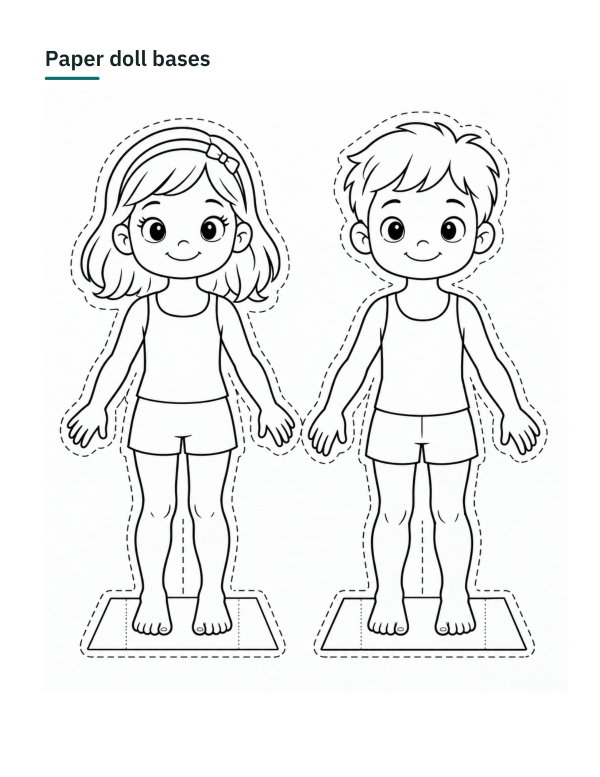
- 2 matched doll bases with fold-back stands (PDF)
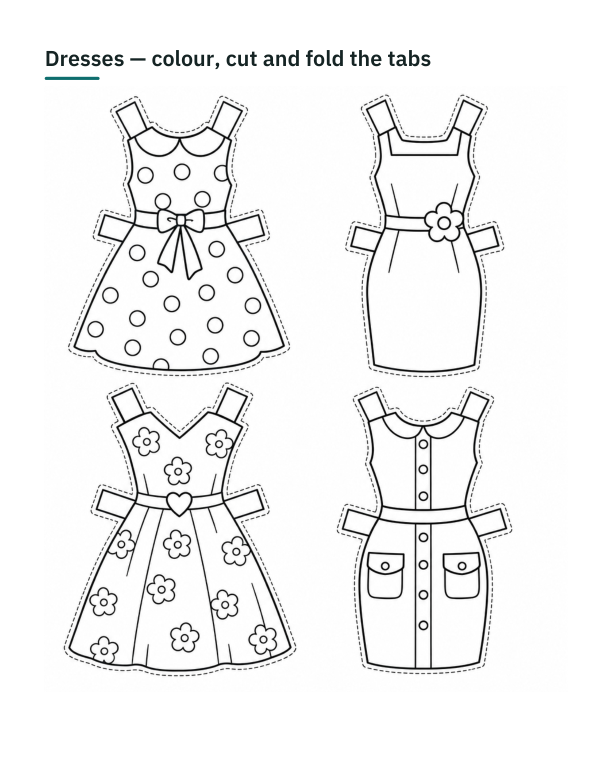
- 16 matched dresses on 4 pages (PDF)
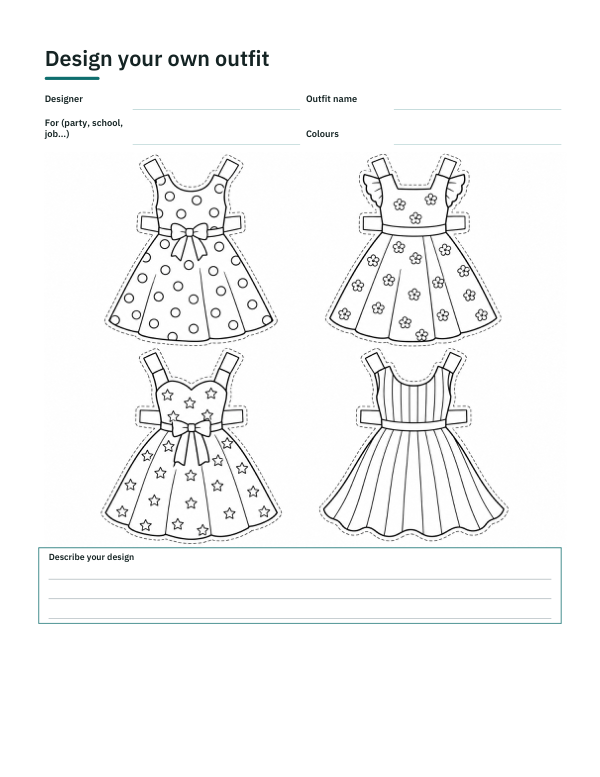
- Outfit-planning form, not a cutting pattern (PDF/DOCX)
- Instructions and ideas (PDF/DOCX)
Formats: PDF, DOCX. Instant download after payment (link valid 72 hours, up to 5 downloads). AI-assisted: the templates were drafted with AI help and reviewed and laid out before publishing.
$5.00 USD, one-time 6 resource files + README (7 files total)
- Instant download
- 7-day refund
- Secure checkout by Stripe
7-day money-back guarantee. Full refund within 7 days of purchase, even after you download.
Free sample: Design Your Own Outfit (PDF, 548 KB)
Full refund within 7 days — see the refund policy and license.
Free printables
All 4 PDFs are free individually (7 pages): two matching doll bases, 16 dresses, a design-planning sheet and instructions. The optional ZIP adds two editable Word documents, not extra illustrations.
 Paper Doll Instructions and Ideas
How to make your paper doll
- Choose the doll’s skin tone, hair colour and hairstyle — or pick “Blank” to colour it in yourself.
- Tick up to four dresses for the wardrobe and pick a colour for each with the colour swatch.
- Add a pattern: polka dots, stripes or hearts.
- For a colouring activity, tick “Black-and-white outlines”.
- Click Print. Landscape orientation fits the doll and four outfits on one page.
- Cut out the doll and the clothes along the solid lines, leaving the dashed tabs attached to the clothes.
Fold the tabs behind the doll’s shoulders and waist to hold the clothes in place, and fold the base back so the doll stands up.
Tips for sturdy paper dolls
- Print on card stock (160–250 gsm or 65–110 lb) for the doll so it stands and survives lots of play; clothes work fine on normal paper.
- Glue the doll onto a cereal box panel for extra strength.
- Laminate the doll or cover it with clear tape so it lasts.
- Cut around the tabs carefully — they are the part most likely to tear.
- Store outfits in an envelope or a small zip bag with the doll.
- Rounded scissors are easier and safer for small children; adults can pre-cut tricky parts.
Why paper dolls are still a great activity
Paper dolls combine several skills in one screen-free activity. Cutting practises fine motor control and hand–eye coordination; colouring and pattern design encourage creativity; dressing the doll and inventing stories builds language and imaginative play. Children can design outfits for different occasions, weather or jobs, which opens conversations about seasons, careers and cultures. Paper dolls also travel well — a folder of dolls and clothes is a quiet activity for journeys, waiting rooms and rainy afternoons.
Dress styles in the maker
| Style | What it looks like |
|---|---|
| A-line | Fitted top with a skirt that gradually widens |
| Sheath | Slim and straight, following the figure |
| Fit and flare | Fitted to the waist with a full, twirly skirt |
| Maxi | Floor-length flowing dress |
| Shift | Straight and loose with short sleeves, no waist seam |
| Empire waist | Seam high under the bust with a flowing skirt |
These are real fashion silhouettes, so older children can learn a little fashion vocabulary while they play.
Design challenges for kids
- Design an outfit for a party, a rainy day and a trip to the beach.
- Make a uniform for a job: doctor, chef, astronaut or firefighter.
- Design a dress inspired by your favourite animal or food.
- Draw clothes from a country you are learning about.
- Make a matching outfit for yourself and the doll.
- Create a fashion show and describe each design to the family.
For classrooms and parties
Paper dolls work well as a craft station at birthday parties, in art lessons and in after-school clubs. For a group, print the black-and-white version so each child colours their own. In classrooms, paper dolls can support lessons on clothing through history, textiles, or describing words in language learning (“a long red dress with white spots”). Teachers can print one doll per child and a shared box of clothes.
Worked example
For a rainy-afternoon craft, a parent chooses a medium skin tone, brown long hair, and three dresses — an A-line in red, a sheath in blue and a fit-and-flare in green — with polka dots. They print on 200 gsm card in landscape, and the children cut out the doll and dresses. The tabs fold behind the doll’s shoulders and waist, and the stand folds back so the doll can take part in a “fashion show” on the table. A second print in black-and-white lets each child colour and pattern extra outfits.
Paper doll history in brief
Paper dolls have been popular for centuries. In the nineteenth century, printed paper dolls with changeable costumes were sold as toys and fashion illustrations, and in the twentieth century magazines and newspapers regularly printed dolls and outfits for readers to cut out. Many families still keep boxes of paper dolls passed down through generations. Making your own continues that tradition, with the added fun of designing the clothes yourself.
Printing at the right size
The browser maker scales the doll and its selected outfits together on one page; its size varies with the wardrobe. The downloadable matched PDF set uses a separate fixed scale: print both doll bases and dresses at 100% / Actual size. Do not mix browser-made pieces with the PDF set. The design-your-own sheet is a planning form, not a fitted cutting pattern. In the print dialog, choose “Background graphics” or “Print backgrounds” to include the colours and patterns.
Privacy
The paper doll is drawn in your browser. Nothing is uploaded or saved, and no account is needed.
Frequently asked questions
How do I print a paper doll?
Choose the doll and outfits, click Print, and select landscape and “Background graphics” in the print dialog.
What paper is best for paper dolls?
Card stock for the doll so it stands up; normal paper is fine for clothes.
Can children colour it themselves?
Yes, tick “Black-and-white outlines” for a colouring page.
How do the clothes stay on?
Fold the dashed tabs behind the doll’s shoulders and waist.
What age is it for?
Ages about 4–10, with adult help for cutting for younger children.
Is it free?
Yes. The four PDF files are free individually. The optional $5 ZIP adds an editable outfit-planning form and instructions in Word, not extra dolls, outfits or accessories.
Can I make boys’ or gender-neutral outfits?
Use the design sheet to plan trousers, shirts, sports kits or costumes. It is a planning form, not a fitted cutting pattern; these outfits are not included in the matched dress PDF.
How long does it take?
About 20–40 minutes to colour, cut and assemble one doll with four outfits.